
Growth exposes every crack in how a product company runs.
The orders come in faster than the floor can see them, custom configurations get tracked on spreadsheets, and customer service spends the day answering the same question about order status. We rebuild the operation piece by piece, in the order that actually unblocks the business.
Start the ConversationThe bottleneck moves every time you fix one.
Manufacturers rarely have a single broken thing. They have a chain, and the moment one link stops constraining the business the next one starts. Orders that need manual entry, a production floor with no visibility into what's coming, a catalog too large for customers to navigate, and a retail or dealer channel running on something disconnected from everything else.
- Orders from the website get re-entered by hand before production sees them
- Custom or configured orders are tracked in spreadsheets
- Customer service is buried in order status questions
- The product catalog is too large for buyers to navigate on their own
- Retail, dealer, and online channels don't share a source of truth
- New product listings take hours of manual writing before they can go live
We start on the floor, not in a spec document.
The reason this work holds up is that we spend time watching how the business actually runs before proposing anything. The people doing the work know where the friction is, and they will tell you once they trust that you aren't there to sell them a platform.
Order flow and production visibility
Orders move from the website into production without anyone re-typing them, and the floor can see what's coming. When customers can check their own order status, the volume of status calls drops on its own rather than being managed.
A catalog buyers can actually use
Large or highly configured catalogs need structure, filtering, and compatibility logic, not just more product pages. For one manufacturer that meant helping customers navigate more than 2,500 firearm variations to find what fit their model.
Content generation instead of content typing
If someone writes descriptions, specs, and variations by hand every time a product is added, that's a tooling problem. We've built generators that produce all of it automatically when a new product goes into the catalog.
The channels connected
Retail point of sale, dealer ordering, and online sales working off the same inventory and the same data, so what sells in one place is accurate everywhere else.
The infrastructure underneath
Hosting, email, accounts, and the IT that everything else depends on, consolidated and managed rather than held together by whoever set it up last.
Three years of rebuilding a growing manufacturer.
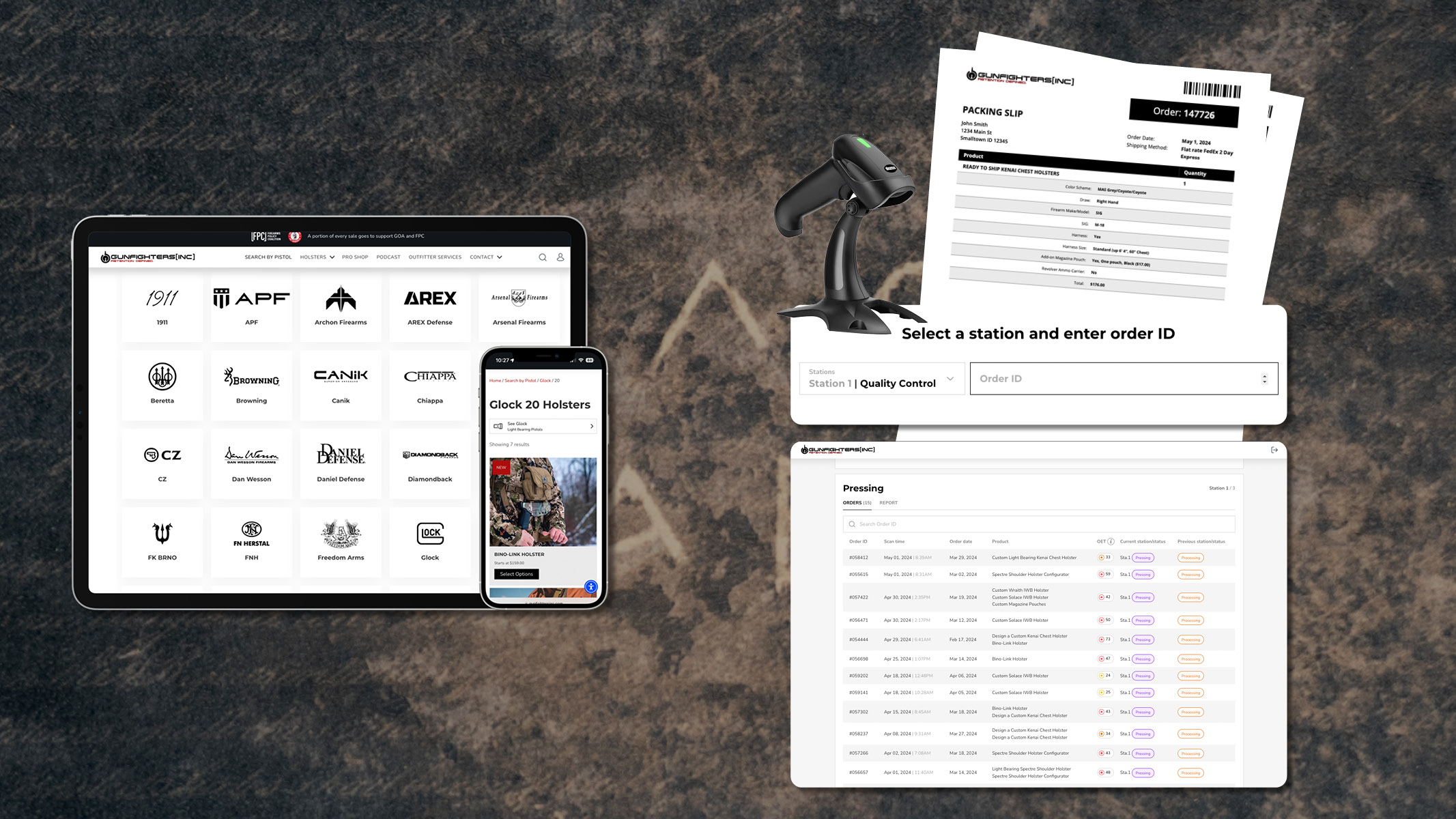
GunfightersINC handcrafts premium Kydex holsters in North Idaho. Demand was strong and the product was exceptional, but custom orders lived on spreadsheets, the production floor had no visibility into what was coming, and customer service was buried in status calls. We spent time on the floor before writing any code, then rebuilt e-commerce, production systems, retail operations, IT infrastructure, and the dealer network over three years.
What changes
- Orders flowing into production without manual entry
- The production floor able to see what's coming
- Customer service handling fewer status calls
- A catalog customers can navigate without help
- Retail, dealer, and online channels working off the same data
- Someone responsible for the infrastructure underneath all of it
Questions we get asked.
We don't need a whole rebuild. Can you fix one thing?
Yes, and that's usually the right way to start. Most of our long-running relationships began with one specific problem. We scope it, fix it, and quote a monthly plan alongside it so what we built stays current. What happens next is your call.
Do you replace our ERP (order and inventory system) or e-commerce platform?
Usually not. Most of the value is in connecting what you already run and building the piece that's missing. Replacing a working system is expensive and disruptive, so we only recommend it when the current one is genuinely the constraint.
How do you learn our process without slowing us down?
We spend time watching how the work actually happens before proposing anything. It's a small amount of your team's time up front and it's the difference between a tool people use and a tool people work around.
What happens after it's built?
You own it. If you want us to keep it current, supported, and improving, that runs on a monthly plan, quoted with the build.
Then somebody keeps it running.
Hosting, domain, email, monitoring, updates, and the changes you need through the year all handled on a monthly plan. It's the reason our clients stay for years rather than calling us again when the next thing breaks.
Start with the bottleneck you already know about.
Tell us how the operation runs today.
Describe the part of your operation that's eating the most time right now. We'll tell you what it would take to fix, whether it's worth building, and roughly what it costs. No charge for the conversation.
We follow up within one business day.